British Grand Prix Terminology Guide: Racing Terms Explained
Attending the British Grand Prix at Silverstone is an exhilarating experience, but the language of Formula 1 can be a barrier for new fans. Understanding key racing terms transforms the spectacle, allowing you to appreciate the strategy, skill, and split-second decisions unfolding on track. This guide decodes the essential terminology you’ll hear over the weekend, from the grandstands to the pit lane.
On-Track Action and Race Control
These terms describe the fundamental elements of the race itself, governed by Race Control at the circuit.
Flags and Signals
Marshals use colored flags to communicate critical information to drivers instantly. Misunderstanding a flag can end a race or cause an accident.
- Chequered Flag: The iconic black-and-white flag signals the end of the race or a session.
- Yellow Flag: Waved to indicate a hazard ahead. Drivers must slow down and are prohibited from overtaking. A single waved yellow signifies great danger, often requiring a driver to be prepared to stop.
- Red Flag: Stops the session or race immediately due to a severe incident or unsafe conditions. All drivers must return to the pits.
- Blue Flag: Shown to a slower driver to indicate that a faster car (usually a leader lapping them) is approaching and they must move aside at the earliest, safe opportunity.
- Black and White Flag: The "driving standards" flag, serving as a warning for unsportsmanlike behavior.
For a deeper dive into how these signals have evolved, explore our article on the history of race control signals at Silverstone.
Overtaking and Defending
Wheel-to-wheel combat is a highlight at Silverstone, a circuit known for its high-speed corners and challenging overtaking opportunities.
- DRS (Drag Reduction System): An adjustable rear wing that drivers can open on designated straights (DRS Zones) to reduce aerodynamic drag and increase top speed, aiding overtaking. Its effectiveness is a key part of race strategy at Silverstone.
- Slipstreaming (or "Towing"): Driving closely behind another car to reduce air resistance. The following car gains a speed advantage, which can be used to attempt a pass, often into a subsequent corner.
- Blocking: A defensive move where a driver changes their racing line to cover the inside of a corner, preventing the pursuing driver from passing. Drivers are allowed one defensive move, but moving in the braking zone is illegal and dangerous.
- Undercut/Overtcut: Pit stop strategies. An "undercut" is pitting earlier than a rival to gain a pace advantage on fresh tires. An "overcut" is staying out longer, hoping to build a gap on worn tires that is large enough to stay ahead after your own later stop.
Car Technology and Setup
Formula 1 is a technical pinnacle. These terms explain the complex machinery battling for victory.
Car Components
- Aerodynamics: The science of managing airflow over the car to create downforce (pushing the car onto the track for better cornering) and minimize drag. Silverstone's high-speed nature makes aerodynamic setup crucial.
- ERS (Energy Recovery System): A hybrid system that harvests energy from braking and exhaust heat, storing it in a battery to provide a power boost (deployed by the driver).
- Power Unit: The modern F1 engine, comprising the internal combustion engine (ICE) and hybrid components (ERS).
- Chassis: The central structural component of the car, to which the engine and suspension are attached.
Performance and Handling
- Downforce: The aerodynamic force that presses the car down onto the track, increasing grip through corners at the expense of some straight-line speed.
- Oversteer/Understeer: Handling characteristics. Oversteer is when the rear of the car loses grip before the front (the car "spins out"). Understeer is when the front loses grip first (the car "plows" wide in a corner).
- Lock-up: When a driver brakes too hard, causing a tire to stop rotating and slide along the track surface, often creating smoke and flat-spotting the tire.
- Graining: When tire rubber overheats and tears, leaving small lumps on the tire surface that reduce grip. This can be influenced by track temperature and conditions.
Race Strategy and Team Communications
What happens off the track is as critical as the driving. These terms reveal the tactical battle.
Pit Lane and Stops
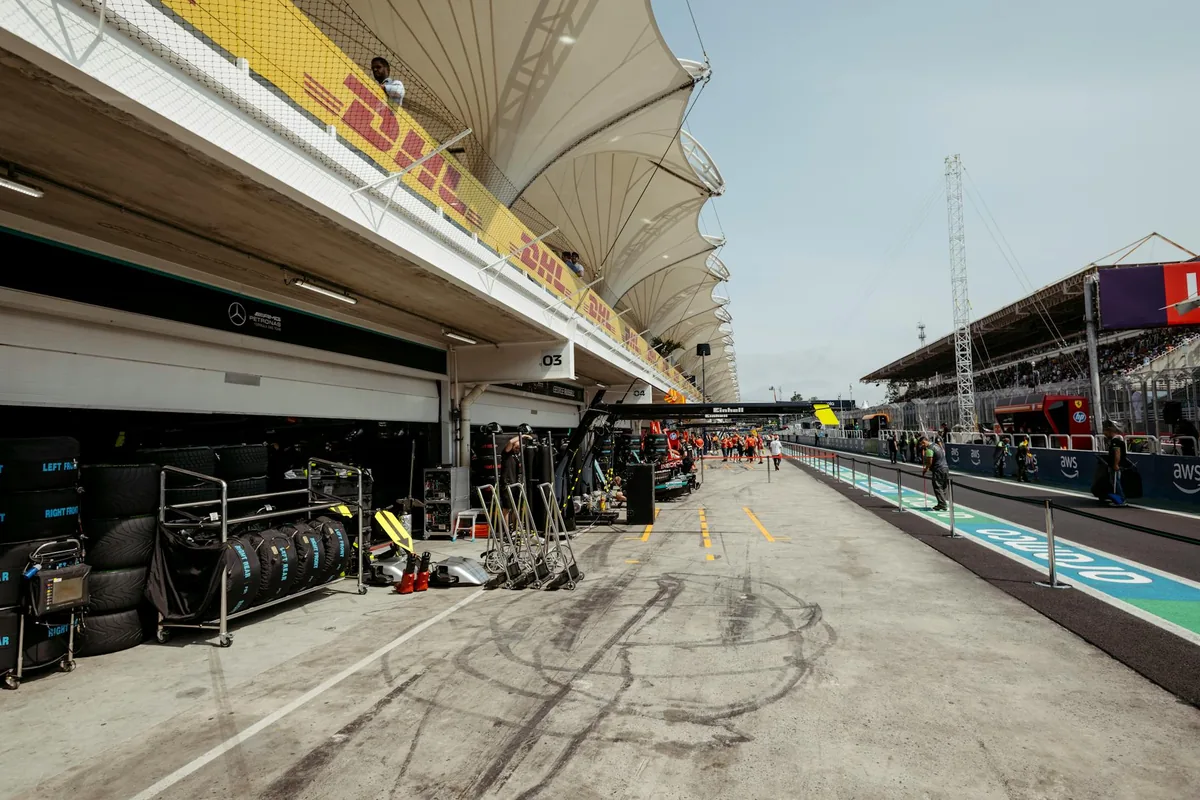
The pit lane is a hive of strategic activity. For a complete look at this critical area, read our guide inside Silverstone's pit lane.
- Pit Stop: When a car enters the pit lane to change tires, make repairs, or adjust the car. A fast stop is typically under 2.5 seconds for a four-tire change.
- Pit Window: The optimal lap range during which a team plans to make a pit stop, based on tire wear and race situation.
- Box, Box: The radio instruction from a race engineer telling the driver to enter the pits immediately.
- Stint: The period of running between pit stops on a set of tires.
Tire Strategy
Tire management is a defining factor in modern F1. Pirelli provides three compounds per weekend: hard (C1-C3, least grip but most durable), medium (C2-C4), and soft (C3-C5, most grip but least durable). Teams must use at least two different dry compounds during the race. Understanding tire strategy at Silverstone is key, as the high-energy corners are particularly demanding on rubber.
Team Radio
Listen for these common phrases in broadcast team radio communications:
- "Push" / "Conserve": Instructions to drive at maximum pace or to save fuel and tires.
- "Gap ahead is 3 seconds, gap behind is 1.5": The race engineer informs the driver of time intervals to the car in front and the car behind.
- "Switch Strat [Strategy] 2": An instruction to change the car's engine and energy recovery settings via controls on the steering wheel.
- "Check your mirrors": A warning that a rival car is close behind, often before a defensive move or a blue flag situation.
Session Formats and Timing
A Grand Prix weekend consists of structured sessions, each with its own purpose and terminology.
- FP1, FP2, FP3 (Free Practice): Practice sessions where teams test setups, gather data, and drivers learn the track conditions. The results do not determine the grid.
- Qualifying (Q1, Q2, Q3): The knockout session that sets the starting grid. Q1 eliminates the slowest five cars. Q2 eliminates the next slowest five. Q3 decides the top ten positions in a shootout for pole position.
- Pole Position: The first place on the starting grid, awarded to the driver who sets the fastest lap in Q3.
- Out Lap / In Lap / Flying Lap: During qualifying, an "out lap" is the lap to leave the pits and prepare the tires. A "flying lap" is the timed, fast lap. An "in lap" is the return to the pits afterward.
- Formation Lap (or Warm-Up Lap): The lap before the race start where drivers take their grid positions, warm their tires and brakes, and complete final checks.
- Safety Car (SC) / Virtual Safety Car (VSC): Deployed after an incident to slow the field. Under a full Safety Car, cars bunch up behind the lead car. Under a VSC, drivers must slow to a mandated minimum time in each marshalling sector, maintaining gaps but at a reduced speed. The FIA's official sporting regulations govern these procedures.
Conclusion: Enhancing Your Silverstone Experience
Armed with this terminology, the sounds and sights of the British Grand Prix will take on new meaning. You'll follow the strategic duel of an undercut, understand why a driver is struggling with graining, and appreciate the precision of a perfect pit stop. The drama of Silverstone is not just in the raw speed but in the intricate layers of technology, strategy, and communication that define Formula 1. For more insights into the venue itself, explore our complete guide to the Silverstone Circuit, and to understand how external factors play a role, read about how weather affects racing at Silverstone. The official Formula 1 website also offers an excellent glossary of terms for further reference.