Silverstone Aerodynamics Setup: The Ultimate Technical Analysis
At the heart of every Formula 1 team's British Grand Prix preparation lies a critical challenge: optimizing the aerodynamic setup for the unique and demanding Silverstone Circuit. This high-speed, flowing track presents a complex aerodynamic puzzle, where teams must balance immense downforce for cornering stability against the drag that penalizes straight-line speed. The perfect aero setup is not a single solution but a delicate compromise, tailored to each car's philosophy and the ever-changing conditions of a Silverstone weekend.
The Aerodynamic Demands of Silverstone's Layout
Silverstone is renowned as one of the ultimate high-speed circuits on the calendar. Its first sector, from Copse through Maggotts and Becketts to Chapel, is a relentless sequence of sweeping, high-g corners that place enormous stress on a car's aerodynamic platform and the driver's neck. Success here is dictated by a car's ability to maintain consistent downforce and stability through rapid directional changes.
This need for high downforce, however, conflicts with the long straights of the Wellington and Hangar Straights, where minimizing drag is paramount for a competitive top speed. Teams analyze every millimeter of bodywork, from front wing angle to rear wing configuration, to find the optimal trade-off. A setup with too much wing will see a car swallowed up on the straights; too little, and it will be vulnerable through the technical sequences. For a deeper understanding of the track's challenges, see our Silverstone Track Layout: Corner-by-Corner Analysis.
Key Aero-Sensitive Corners
- Copse (Turn 9): A flat-out corner in modern F1 cars, taken at over 290 km/h. It requires immense front-end downforce and a stable rear to prevent snap oversteer on entry.
- Maggotts & Becketts (Turns 10-13): This chicane-like sequence is an aerodynamic litmus test. Cars must transition smoothly from one high-speed direction change to the next, demanding a perfectly balanced aero map that doesn't unsettle the car.
- Stowe (Turn 15): A heavy braking zone after a long straight, but the corner exit is crucial for the following straight. Good aerodynamic stability under braking and traction on exit are key.
Critical Aero Components and Their Silverstone Setup
Each aerodynamic component on a modern Formula 1 car plays a specific role, and their settings are finely tuned for Silverstone's characteristics.
Front and Rear Wings
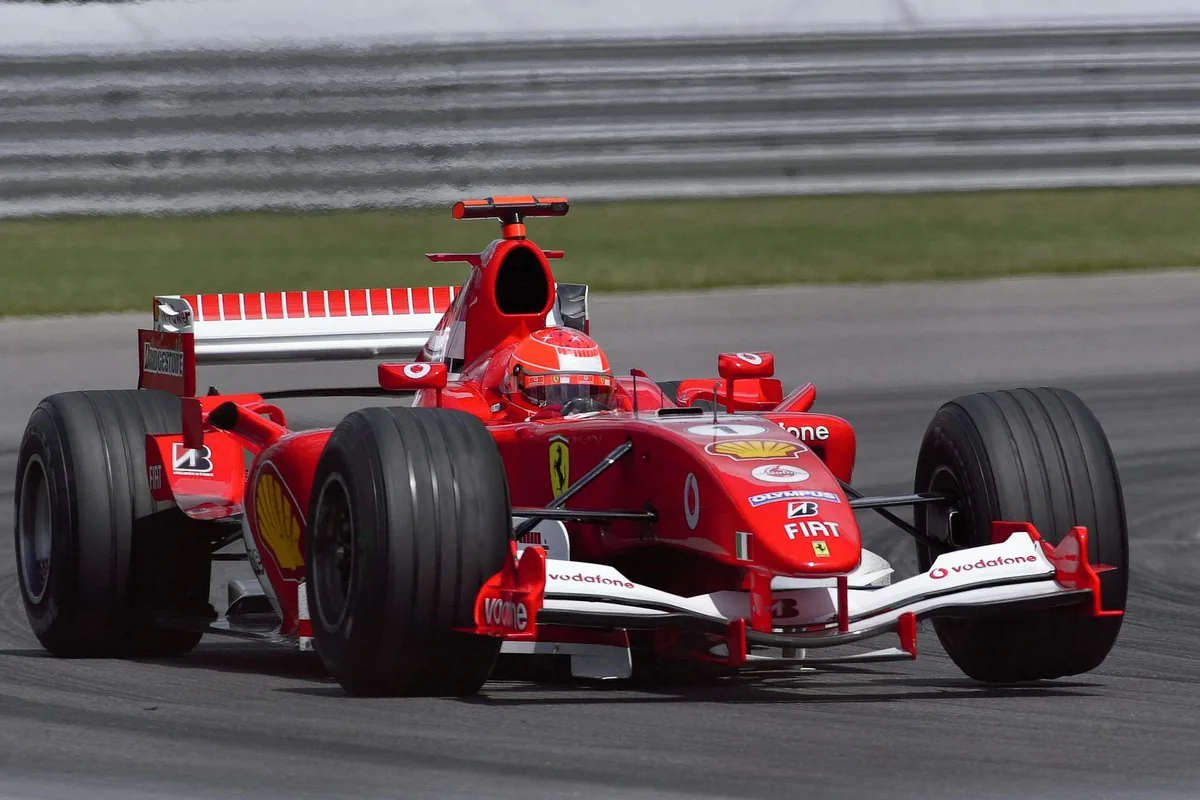
The wing settings are the primary tools for the downforce-drag trade-off. At Silverstone, teams typically run a medium-to-high downforce configuration. The rear wing is often a telling sign: it will have a steeper angle than at a pure power circuit like Monza, but shallower than at a maximum-downforce track like Monaco. The front wing is adjusted in tandem to maintain the car's balance, ensuring the front tires have enough grip to turn into high-speed corners without understeer.
Bargeboards and Floor
While visible wings get the attention, the complex bargeboards and the underfloor are where significant aerodynamic performance is generated. These components manage the turbulent airflow around the car's sides and channel it to seal the diffuser at the rear, creating ground effect downforce. Silverstone's bumps and kerbs can disrupt this sensitive airflow, making the car's ride height and platform stability critical. Teams run simulations to ensure the floor "skirts" the track surface consistently without bottoming out, which would cause a sudden loss of downforce.
Brake Ducting
Aerodynamics also play a vital role in cooling. The fast nature of Silverstone means less time on the brakes, but the loads are immense when they are used. Brake duct sizing is a careful compromise: large ducts provide necessary cooling for the carbon brakes but increase aerodynamic drag. Teams will run the smallest duct size they believe is safe for the race conditions, a calculation heavily influenced by Weather at Silverstone: How Conditions Affect the Race.
The Impact of External Factors on Aero Performance
A perfect garage setup can be undone by Silverstone's famous variable conditions. Wind is perhaps the most significant external aerodynamic factor. A strong crosswind through the open expanses of the circuit, particularly at Chapel or Becketts, can destabilize a car, making it unpredictable and increasing drag. Teams use sophisticated weather monitoring, like the systems detailed in our article on Weather Monitoring: Silverstone's Advanced Forecasting Systems, to anticipate these changes and may adjust wing angles or balance for qualifying versus the race.
Track temperature also affects aerodynamic efficiency. Hotter track surfaces heat the tires, increasing grip and allowing a slightly lower downforce setup. Conversely, cooler conditions demand more mechanical and aerodynamic grip to get the tires into their optimal operating window.
Simulation, Data, and the Pursuit of Perfection
Modern F1 aero setup is a data-driven science. Long before the cars arrive in Northamptonshire, teams run thousands of computational fluid dynamics (CFD) simulations and wind tunnel tests with scaled models. They simulate Silverstone's corner profiles to understand how their car will behave. During the race weekend, this virtual work is complemented by real-world data from practice sessions. Sensors measure ride height, downforce levels, and airflow, allowing engineers to validate their models and make precise adjustments. This relentless pursuit of aerodynamic optimization is a key part of the Silverstone Circuit: Engineering Marvels Behind the Scenes that fans seldom see.
Strategic Implications of Aero Setup
The chosen aerodynamic package has direct consequences for race strategy. A higher-downforce setup may qualify well but leave a car defenseless on the straights during the race, vulnerable to DRS-assisted overtakes. This influences where drivers can attack and defend, as analyzed in our guide to Passing Lanes: Analyzing Overtaking Opportunities at Silverstone.
Furthermore, a stable aero platform is kinder to the tires. A car that slides less maintains its tire life longer, potentially enabling a one-stop strategy. A nervous, unstable car will degrade its tires faster, possibly forcing a two-stop plan. Thus, the aerodynamic setup is intrinsically linked to the Tyre Strategy at Silverstone: Pirelli's Challenge.
Conclusion: The Never-Ending Compromise
The aerodynamic setup for the Silverstone Grand Prix remains one of Formula 1's most intricate technical challenges. It is a three-dimensional optimization problem balancing downforce, drag, cooling, and stability, all while adapting to the capricious British weather. The teams that best interpret the data, understand the trade-offs, and give their driver a car that is both planted through Becketts and swift on the straights will be the ones contending for victory at this historic circuit. For a broader look at how the track itself has been modified to suit evolving car aerodynamics, explore How Silverstone Circuit Has Changed: Major Modifications Through History.
To understand the official regulations governing the aerodynamic components discussed, the FIA's Formula 1 Technical Regulations provide the definitive framework. Additionally, advanced aerodynamic principles are often explored in publications like SAE International's technical papers, which detail the engineering science behind motorsport performance.